Every field has a story, and the story of cybernetics is a particularly rich one, full of wartime urgency, unlikely friendships and ideas that travelled much further than their makers expected. Here it is in brief, from its roots to the present day.
Before the name (to 1943)
The word “cybernetics” only came into wide use in 1948, when Norbert Wiener chose it as the title of his book. The ideas behind it are much older: for more than a century before that, engineers and physiologists had been studying how machines and living bodies keep themselves steady. James Watt’s centrifugal governor (1788) regulated steam engines by feedback. James Clerk Maxwell analysed governors mathematically in 1868. The physiologist Claude Bernard described the body’s milieu intérieur, and Walter Cannon named its self-regulation “homeostasis” in 1926. In his Essai sur la philosophie des sciences (1834–1843), André-Marie Ampère even proposed cybernétique as the name for the science of government. In Russia, Alexander Bogdanov’s Tektology (1913–1922) proposed a universal science of organisation that anticipated much of what came later.
The founding moment (1943–1953)
During the Second World War, Norbert Wiener and the engineer Julian Bigelow worked on predicting the path of enemy aircraft so that anti-aircraft guns could aim ahead of them. The pilot, the plane, and the gun formed one loop. Wiener realised that the same mathematics described a human hand reaching for an object.
In 1943 two papers appeared that are usually treated as the field’s birth certificates:
- “Behavior, Purpose and Teleology” by Arturo Rosenblueth, Norbert Wiener, and Julian Bigelow, which argued that purpose could be explained by negative feedback.
- “A Logical Calculus of the Ideas Immanent in Nervous Activity” by Warren McCulloch and Walter Pitts, which modelled neurons as logical switches.
From 1946 to 1953 the Josiah Macy Jr. Foundation funded ten meetings in New York, chaired by McCulloch, on “circular causal and feedback mechanisms in biological and social systems.” Wiener published Cybernetics in 1948, and the conferences adopted the word. In Britain, the Ratio Club (1949–1958) gathered Ross Ashby, W. Grey Walter, Alan Turing, and others around similar questions.
Expansion (1950s–1960s)
The 1950s and 1960s were the field’s period of greatest prestige. Ashby published Design for a Brain (1952) and An Introduction to Cybernetics (1956). Heinz von Foerster founded the Biological Computer Laboratory at Illinois in 1958. Stafford Beer applied cybernetics to steel companies and later governments. Gordon Pask built teaching machines and interactive art.
Cybernetics also crossed the Iron Curtain. Denounced in the USSR in the early 1950s as a “reactionary pseudoscience,” it was rehabilitated after Stalin’s death and by the early 1960s was promoted as the science of communist planning. Qian Xuesen’s Engineering Cybernetics (1954) shaped Chinese engineering after he returned to China in 1955.
Turn and dispersal (1970s–1980s)
In the 1970s two things happened at once, and they pulled the field in opposite directions. First, the term second-order cybernetics appeared: Margaret Mead, Heinz von Foerster, Humberto Maturana, Francisco Varela, and others turned cybernetic tools on the observer, asking how knowledge itself is produced. Second, the field’s funding and institutions dissolved. Military research money in the US moved to artificial intelligence and computer science, and the Biological Computer Laboratory closed around 1975–76.
Meanwhile, the most ambitious applied project took place in Chile. From 1971 to 1973, Stafford Beer worked with the Allende government on Project Cybersyn, a network for managing the nationalised economy in near real time. It ended with the coup of 11 September 1973.
Diffusion and return (1990s–today)
From the 1990s cybernetics was most visible as a prefix: cyberspace, cyberpunk, cybersecurity. The science itself lived on in management (the Viable System Model), family therapy, constructivist education, cognitive science (enaction, the free energy principle), and design.
Since the 2010s there has been a revival. Historians such as Ronald Kline, Eden Medina, Andrew Pickering, and Benjamin Peters have rewritten the record. The Australian National University opened a School of Cybernetics. The rise of machine learning, which runs on feedback, has sent many people back to Wiener’s warnings about machines that pursue goals we did not quite intend.
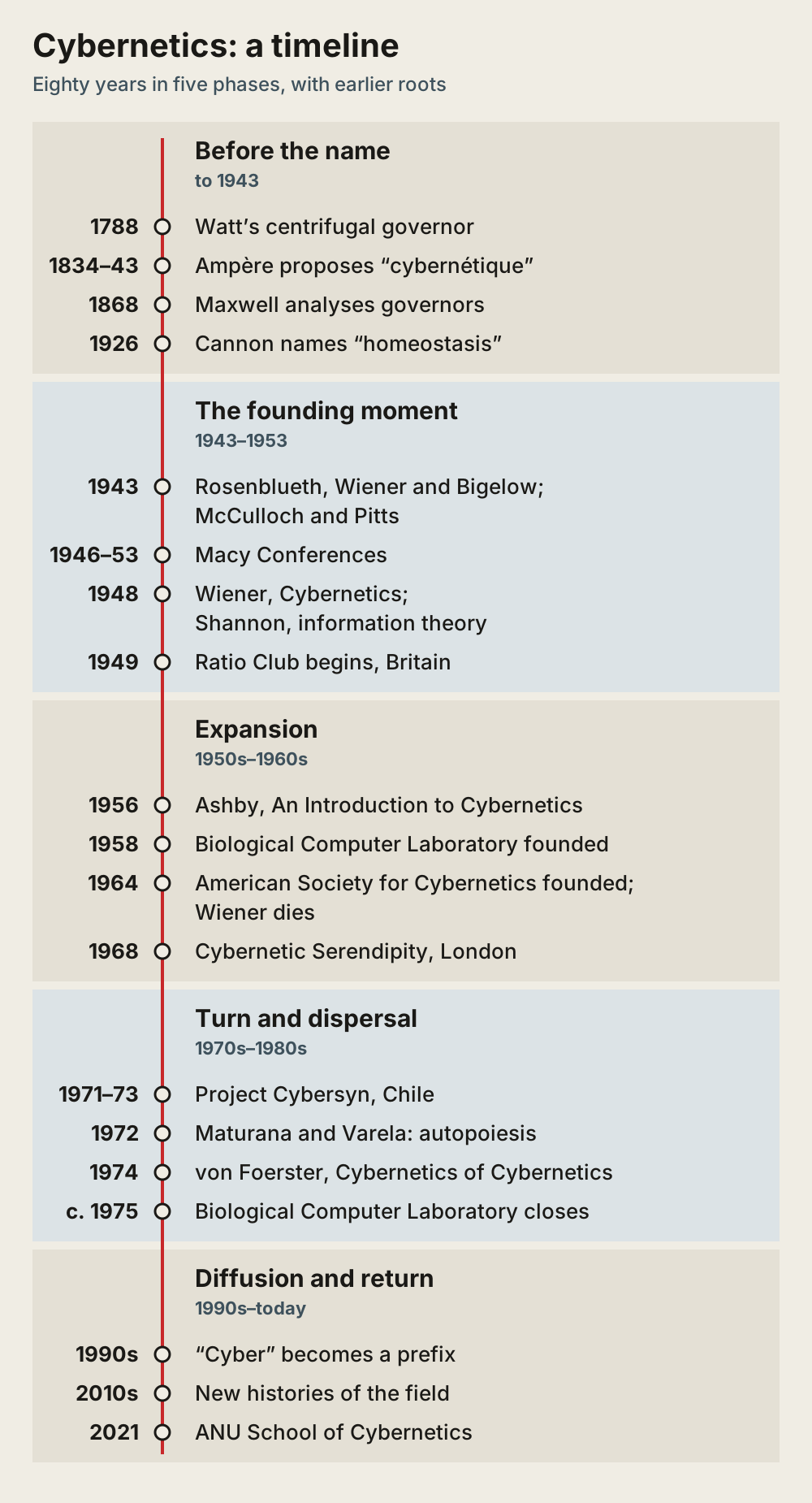
Timeline
Further reading
- Steve Joshua Heims, The Cybernetics Group (1991)
- Thomas Rid, Rise of the Machines: A Cybernetic History (2016)
- Ronald Kline, The Cybernetics Moment (2015)